Tax-Ready Books All Year vs. the January Catch-Up: What It Really Costs
November 25, 2026
Catching up a year of books in January costs more than keeping them current. What it really costs, and what tax-ready books look like month by month.
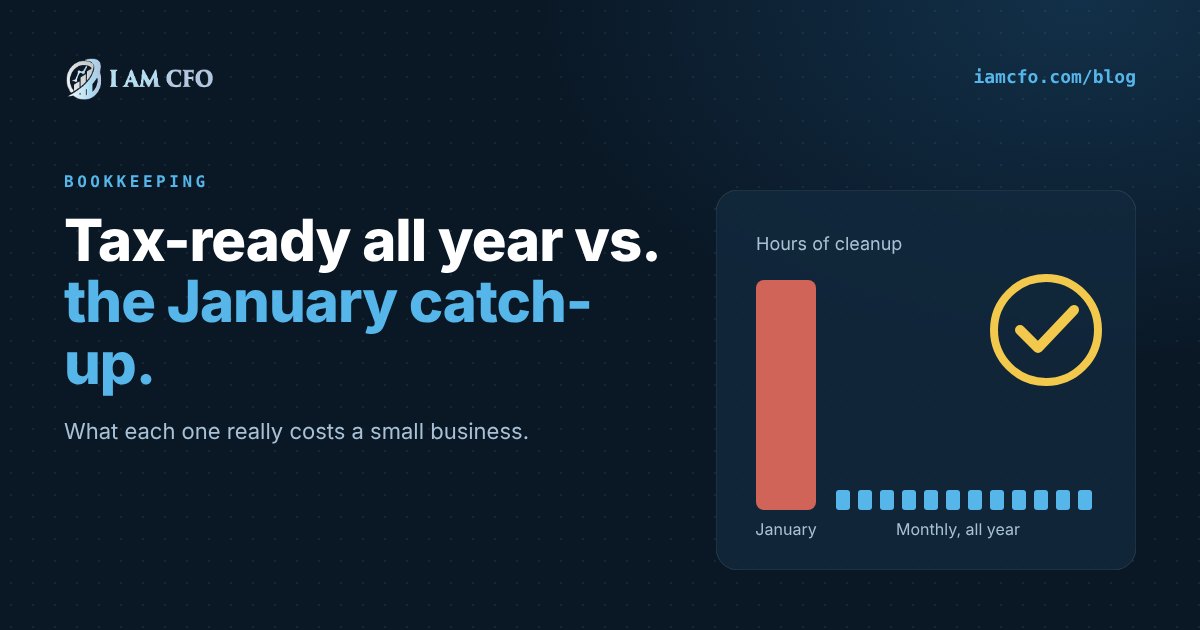
Two ways to get to a tax return
Every business ends up with a tax return. The difference is how the books get there. Some owners keep them current every month, so in January there is little left to do. Others let the year pile up and catch it all up when the return is due.
The catch-up feels cheaper because you only pay once. In practice it usually costs more, in money and in decisions you could have made during the year.
What the January catch-up actually costs
- Memory. In January nobody remembers what a deposit in May was for, or whether a $3,000 charge was a repair or a new machine. Every question goes back to the owner, and the guesses go on the return.
- Missed deductions. Receipts that were never matched, mileage that was never logged and equipment that was booked as supplies all cost money on the return, and some can't be fixed after the fact.
- Extensions. A year that is still being reconciled in March often means filing an extension. An extension gives more time to file, not more time to pay, so the tax still has to be estimated by the original date.
- Estimated taxes. Without current numbers, quarterly estimates are guesses, which means either overpaying all year or a surprise bill and underpayment penalties.
- A year of decisions made blind. Hiring, pricing, buying equipment, taking on a loan: all decided without knowing what the business actually earned.
What tax-ready books look like
Tax-ready books are not complicated. They are a short routine done every month instead of once a year:
- Every bank, card and loan account reconciled to its statement, every month.
- Deposits matched to invoices and bills matched to payments, so income is counted once.
- Holding accounts cleared: nothing left in uncategorized income or expense, suspense or "Ask My Accountant".
- Owner money kept separate: personal charges, draws and contributions recorded as what they are.
- Equipment recorded as equipment, with the date it went into use, so depreciation is right.
- Payroll tied out to the payroll reports each quarter.
Done monthly, each of these takes minutes. Done in January for twelve months at once, they take weeks.
What changes for the owner
The real payoff isn't the return. It's knowing your numbers while they can still change something: cash and profit as of today, not as of last year; quarterly estimates based on real income; and a March that is a review of a return built from books you already trust.
How we do it
At I AM CFO we keep your books current every month in your own QuickBooks or Xero, and the software shows your cash, profit and balance sheet live every day. Every correction is proposed with the reason behind it, and nothing changes without your approval. At tax time we prepare the business return from those same reconciled books, or hand them to your CPA.
Already behind? We start with a fixed-price cleanup of the period you name, and monthly bookkeeping picks up from there. The free QuickBooks audit shows where you stand in a couple of minutes.
Written with help from AI and reviewed by Greg Pober, PTIN-registered tax preparer at I AM CFO. This article is general information, not tax advice for your situation.
Frequently asked
- Is it cheaper to catch up bookkeeping once a year?
- Usually not. A year-end catch-up takes longer per month of books, misses deductions nobody remembers, and often leads to extensions and estimated-tax guesses.
- What does tax-ready mean for small business books?
- Every account reconciled to its statement, income counted once, holding accounts cleared, owner money kept separate, equipment recorded with its in-service date, and payroll tied out.
- Does an extension give more time to pay taxes?
- No. An extension gives more time to file the return; any tax owed is still due by the original date.
See your own numbers this way
I AM CFO turns the books you already keep into a live forecast you can question in plain English.
Connect QuickBooks or Xero read-only and see what's off in minutes.